

The article below IS NOT meant to be educational in any way other than to help convince people to use caution when approaching the prospect of recapping retro machines, and not to do it ‘just because’.
Is recapping nessecary?
Well, Tonya Harding thought so… What? Oh that was KNEE-CAPPING! But, depending on who you let touch your retro hardware, either action could occur.
Lately it seems, a new trend has permiated it’s way thru the different retro communities. That new trend is recapping retro systems; and by that I mean replacing all electrolytic capacitors on 30 to 5o year old retro systems. Whether it be an Atari 2600 or, yes, a CoCo. Let’s start out by saying, I am vehemently again the arbitrary use of heat on old printed circuit boards, without a justifiable reason.
Recently, I’ve been working on several projects, but the most recent one is a textbook example of WHEN to replace capacitors. The subject isn’t a CoCo, but since it first hit the market at the end of the crappy capacitor era in 2009, it’s almost retro. It’s a Sonos Play:5 Gen 1. When I took ownership, it had an issue – the indicator LED would blink white, and that’s it.
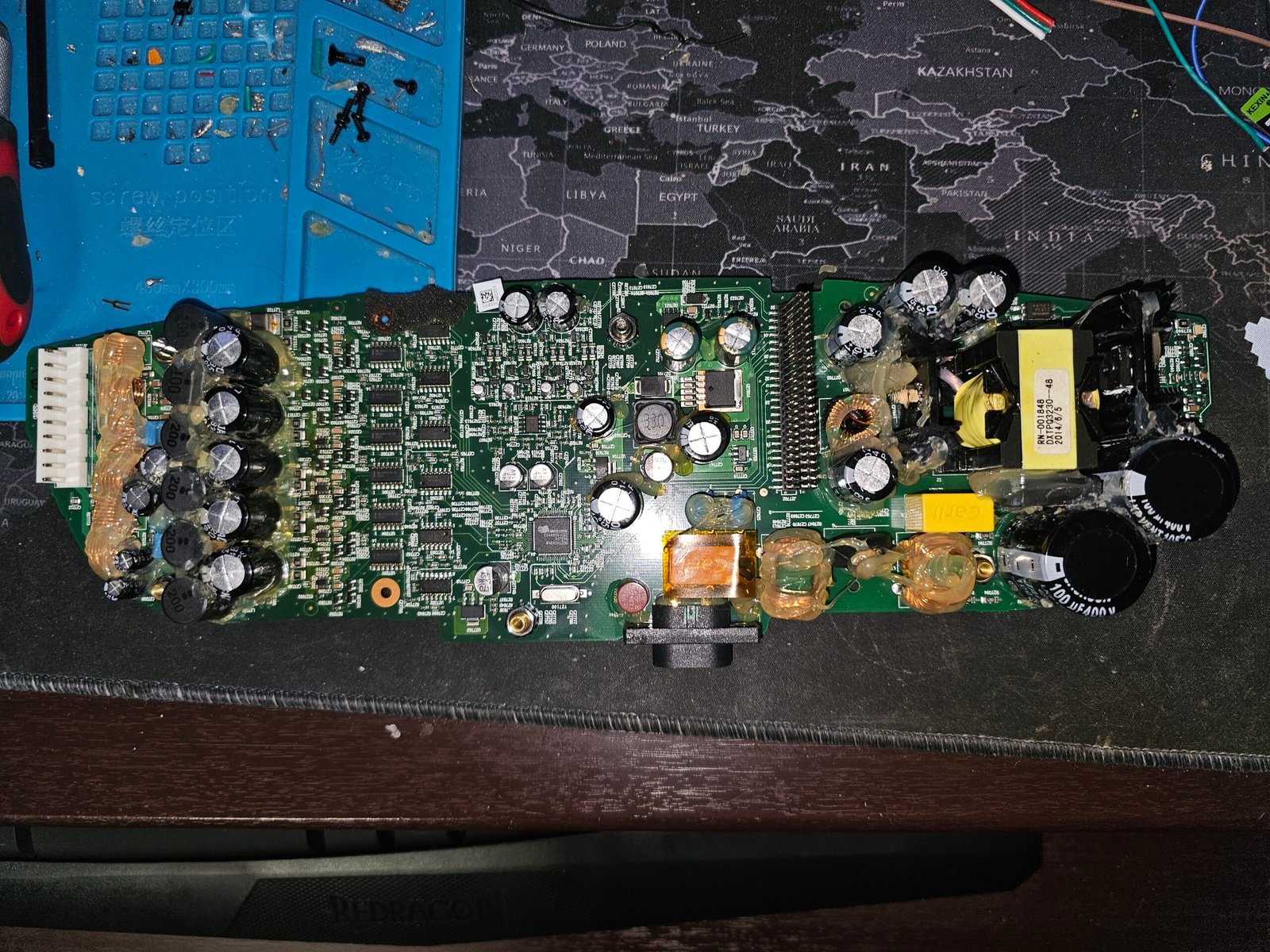
Just from the power supply (on the right side above), there doesn’t appear to be much going on here. There is, but I’m awaiting parts to finish that area. The audio amp section on the left, is a major part of the story – and it’s a sad and ugly story. Never mind all of the anti-vibration silicone in use (that also retains heat), which also took me hours to remove enough, with a judicial use of hot air and tweezers, to work on this.
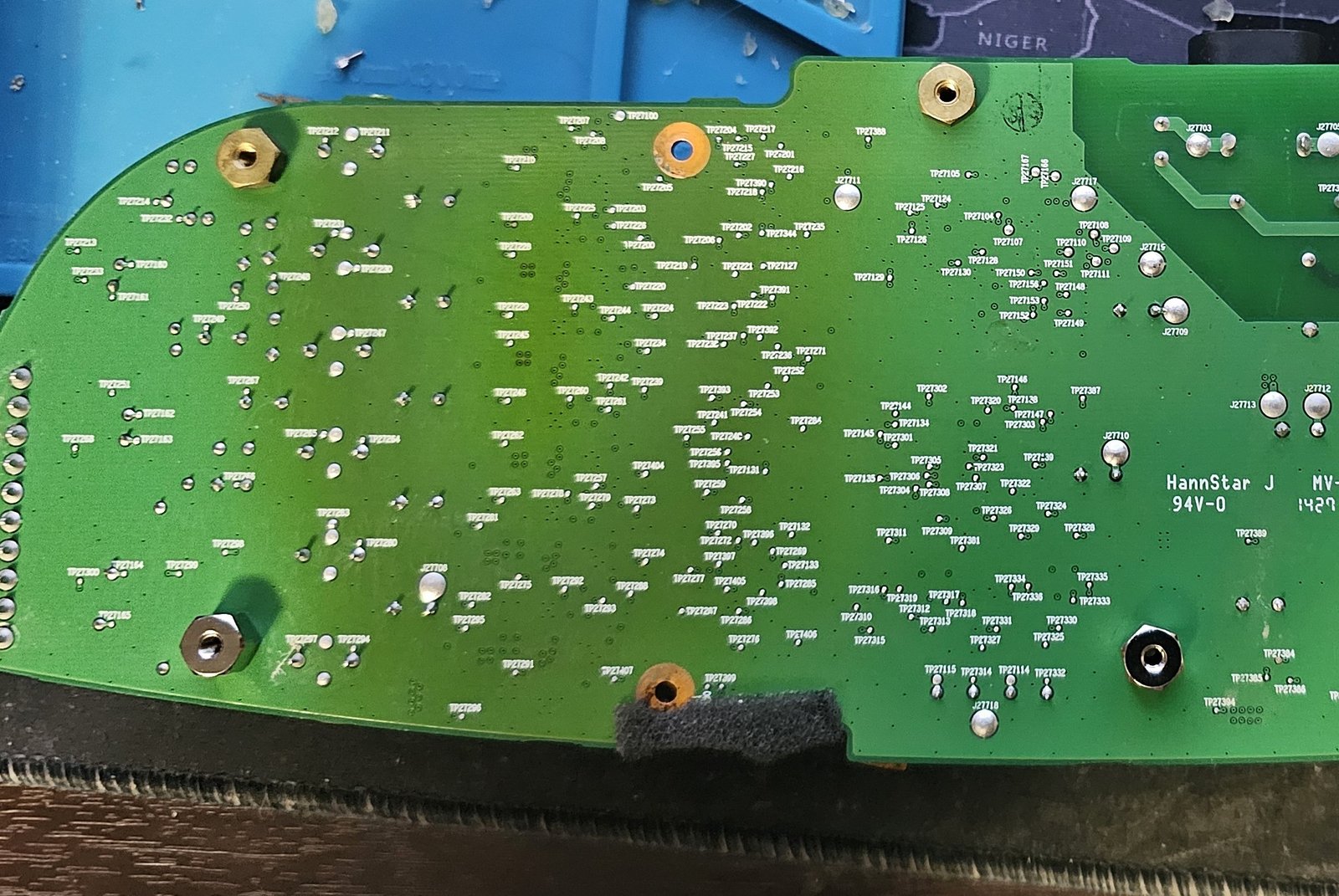
As you can see, the PCB under the audio amp section has gotten…. toasty. To the point where I’m not even 90% sure this board is savable. But, I’m not one to just throw in the towel…
It should be mentioned there are a number of tools that should be utilized when examining electronics. The first being your eyes, as they really help to pick up on signs like damage from impact, vibration, and heat. I’ve also found that using the force or hoping to gain some insight thru osmosis rarely works.
I should also mention that I’m not an electronics engineer. I WAS an Electronics Technician in the Navy, with a specialty in shore based communications and surface search radar. This was back in the 90’s and my recent attempts to shake the rust off of those brain cells has been met with successes, and failures. That’s life…
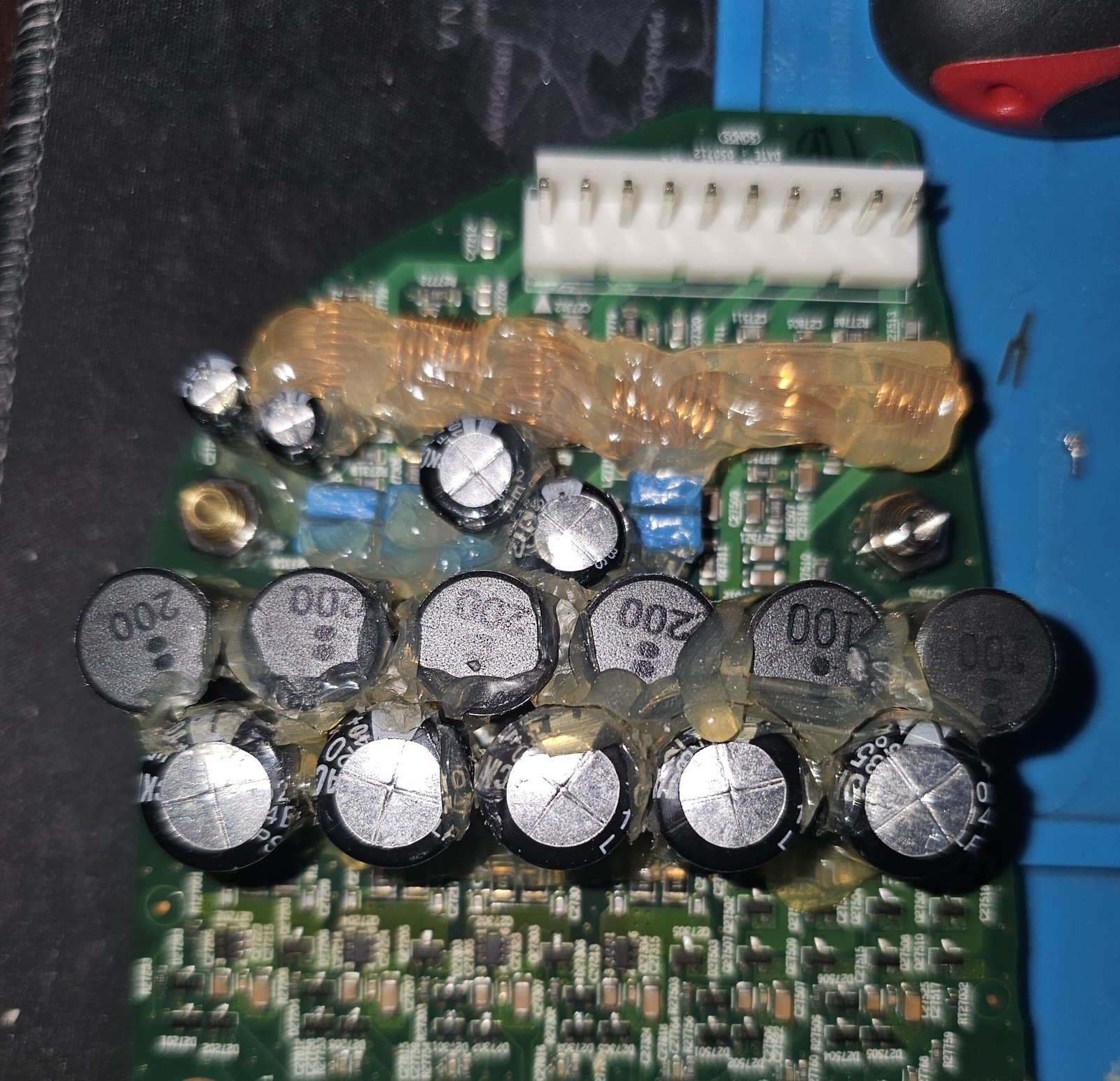
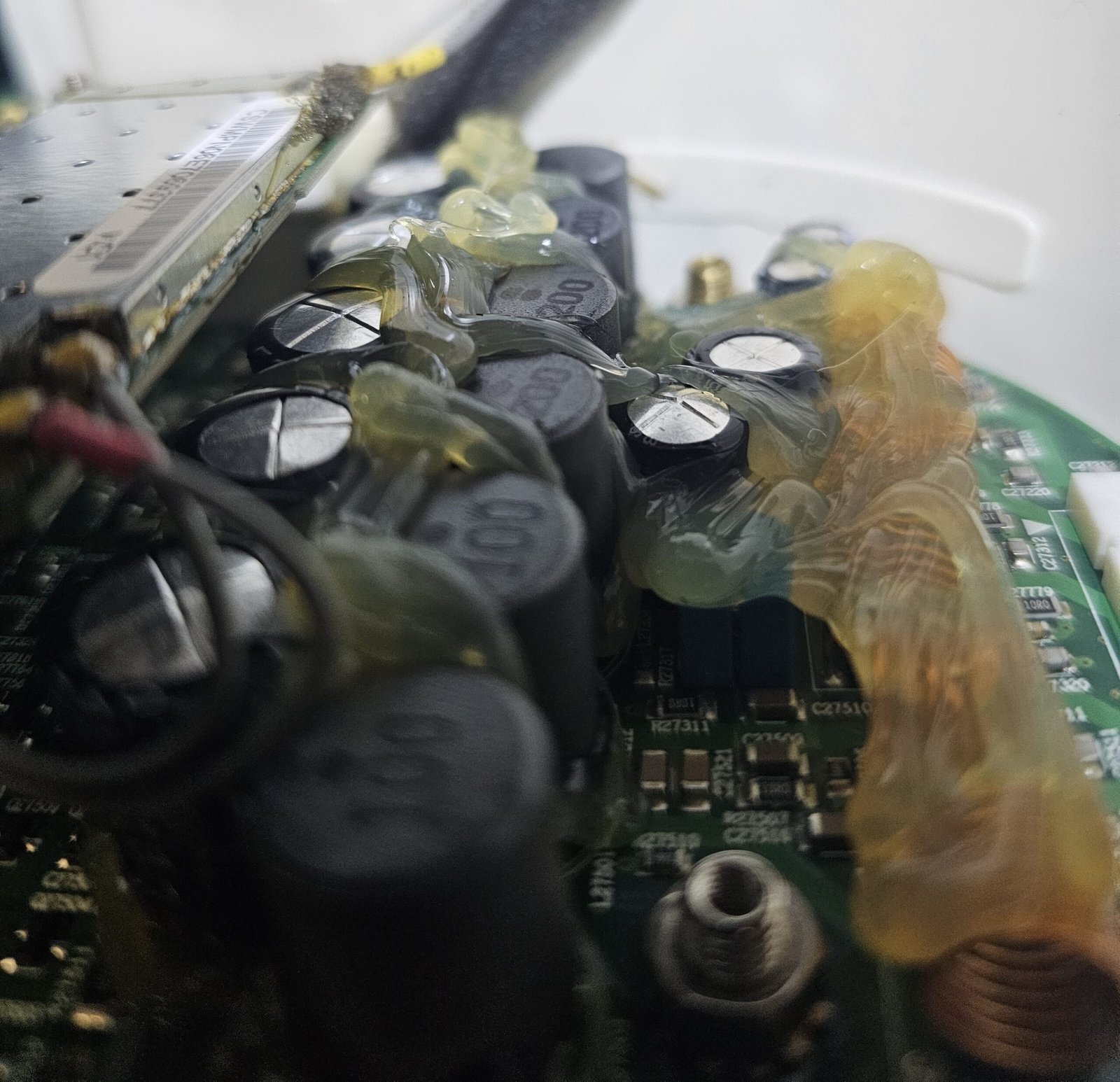
If you’re new to electronics, you may or may not notice the capacitor row, with inductors (stamped 200 & 100) – this is a Class D amp stage, and these devices are part of the low pass filtering circuit. As you can see in the second image, they (the caps) also have a discernable, unwanted feature – a bulge. That would be a first visual clue that these caps have issues, and should be replaced – to keep this somewhat CoCo related, I have repaired MANY CoCo variants since 2006 when I first got back into CoCoLand – probably 50ish. Not once have I seen a bulging capacitor in a CoCo. I’m not saying it never happens, however. there’s also the possibility that a cap looks perfectly good, and is still bad. That’s where other tools come into the game…
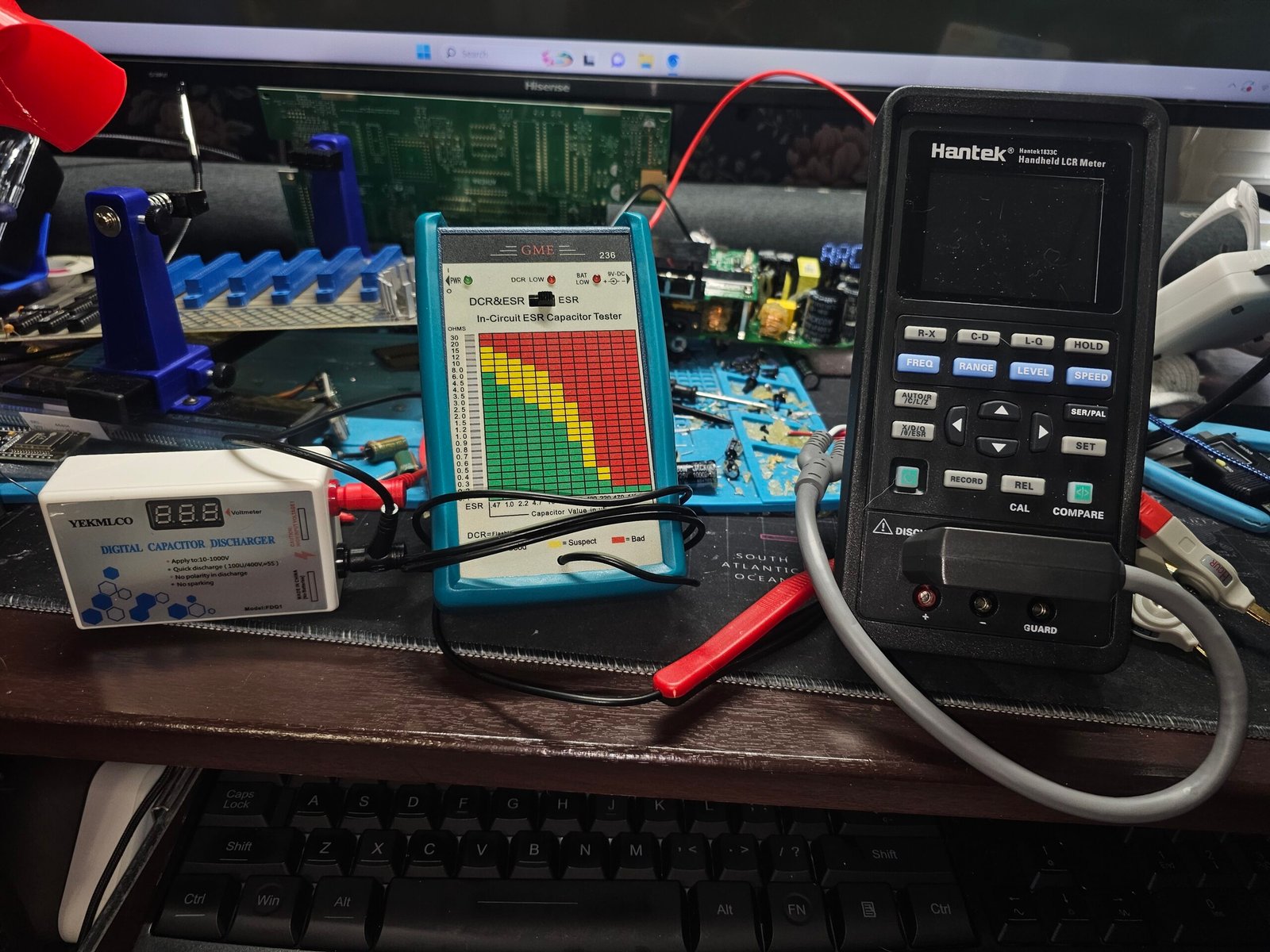
From left to right, these are what I use:
(I’m blatantly omitting the venerable multimeter as a test tool for capacitors here, as it isn’t really useful for in circuit testing)
Capacitor discharger: this audio board has two 400v caps on it. Trust me, you do not want to physically interact with that. I discharge everything, whether I think it needs it or not. I’ve been hit by high DC voltage, it really sucks. Especially since I didn’t even get any super powers from it…
The next two are ESR meters, that test capacitors in a similar fashion to each other, but different enough to make them equally useful to have both, in my opinion (which may not be worth much).
The first is the GME 236; it can test DC resistance (DCR) and Equivilant Series Resistance (ESR) or just the ESR of a capacitor in cirut. DCR & ESR is done by measuring the resistance to DC of the cap. if it’s less than 30 ohms, it assumes a short (capacitors should read open to DC current). The ESR test is done with a 100kHz signal at 600mV so as not to bias any PN junction devices (diodes, etc…), and measure the equivalent resistance of the cap in question.
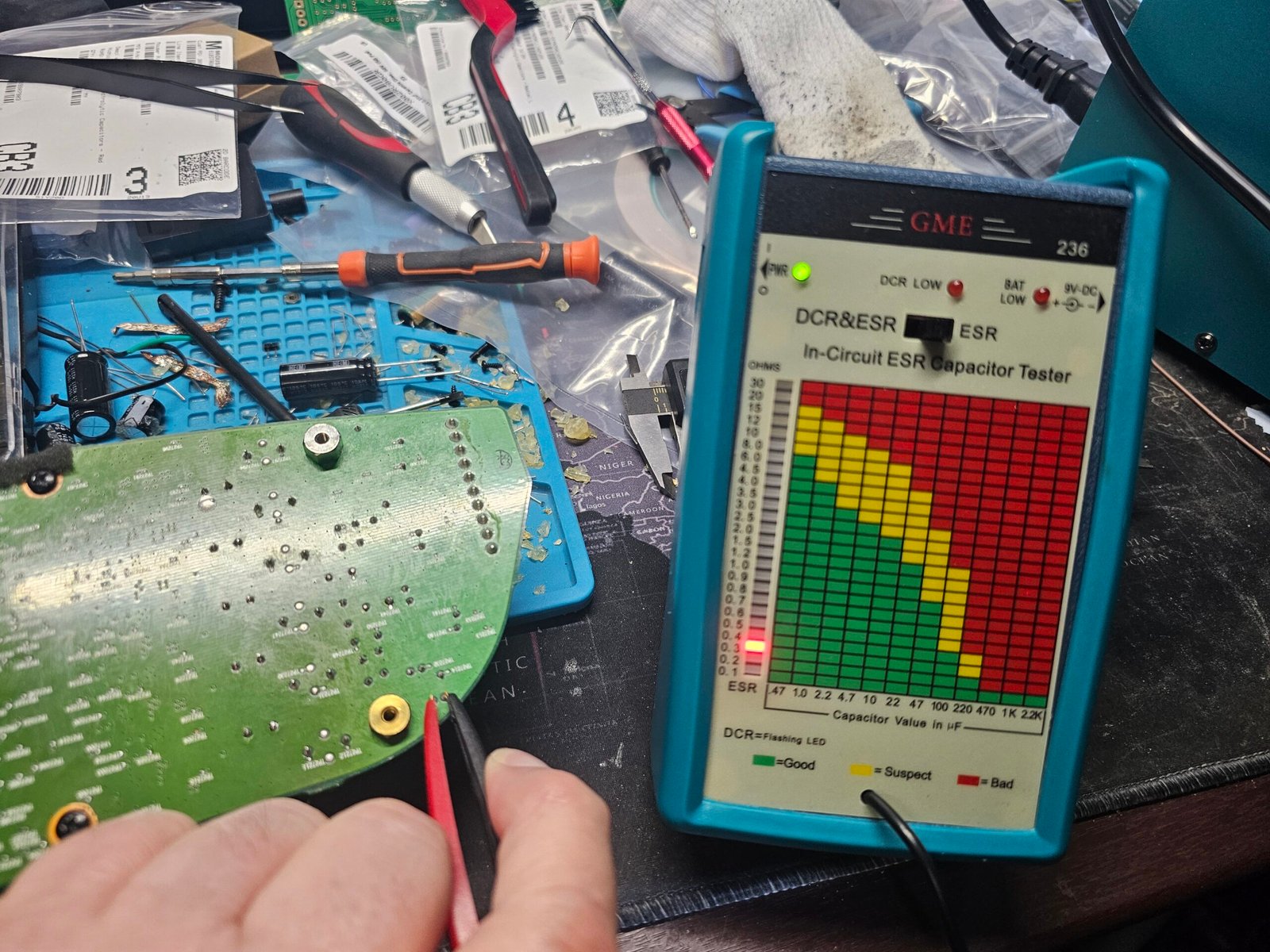
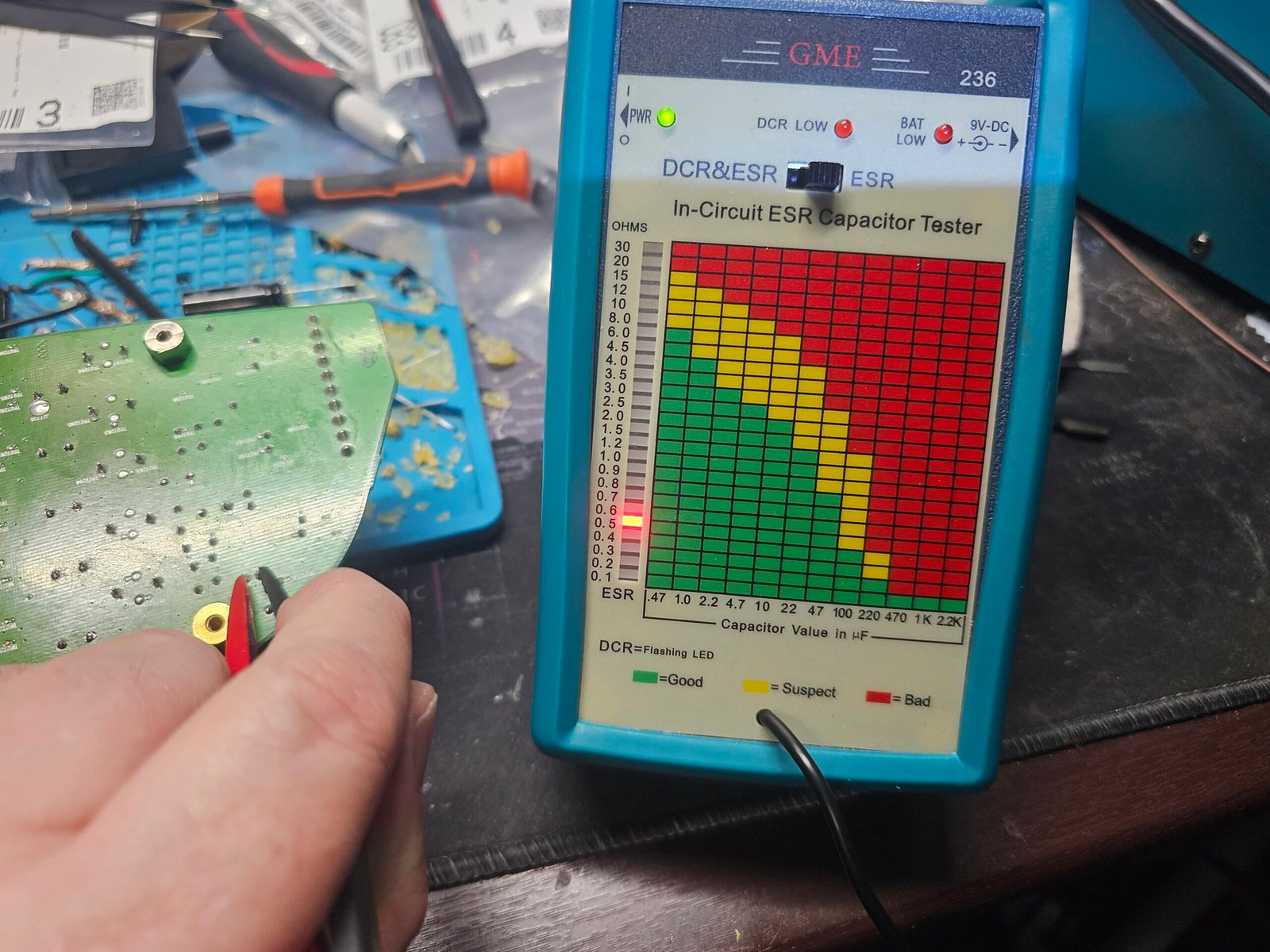
Using the GME 236 is fairly simple. The left column shows the ESR measurement with an illuminated LED; the bottom scale shows capacitor values from .47 to 2200uF (2.2kF) running from left to right. Where the measurement LED lights up to, follow that row to the right to find the capacitor value. Green is good, Yellow is questionable, red is bad. In the images above, I’m measuring two 100uF 25v caps. One is reading good, the other is questionable.
No tool is perfect, and this is no different, but when trying to track down problems, especially related to power, and the capacitors are suspect, it’s a great tool when everything is still in circuit.
As stated Above, I’m testing two 100uF 25v caps; one you can see is basically good (left) and the, not so good (right). The kicker here is that the caps are in parallel, so the readings can be a little skewed – you will ALWAYS get a more accurate reading when testing out of circuit.
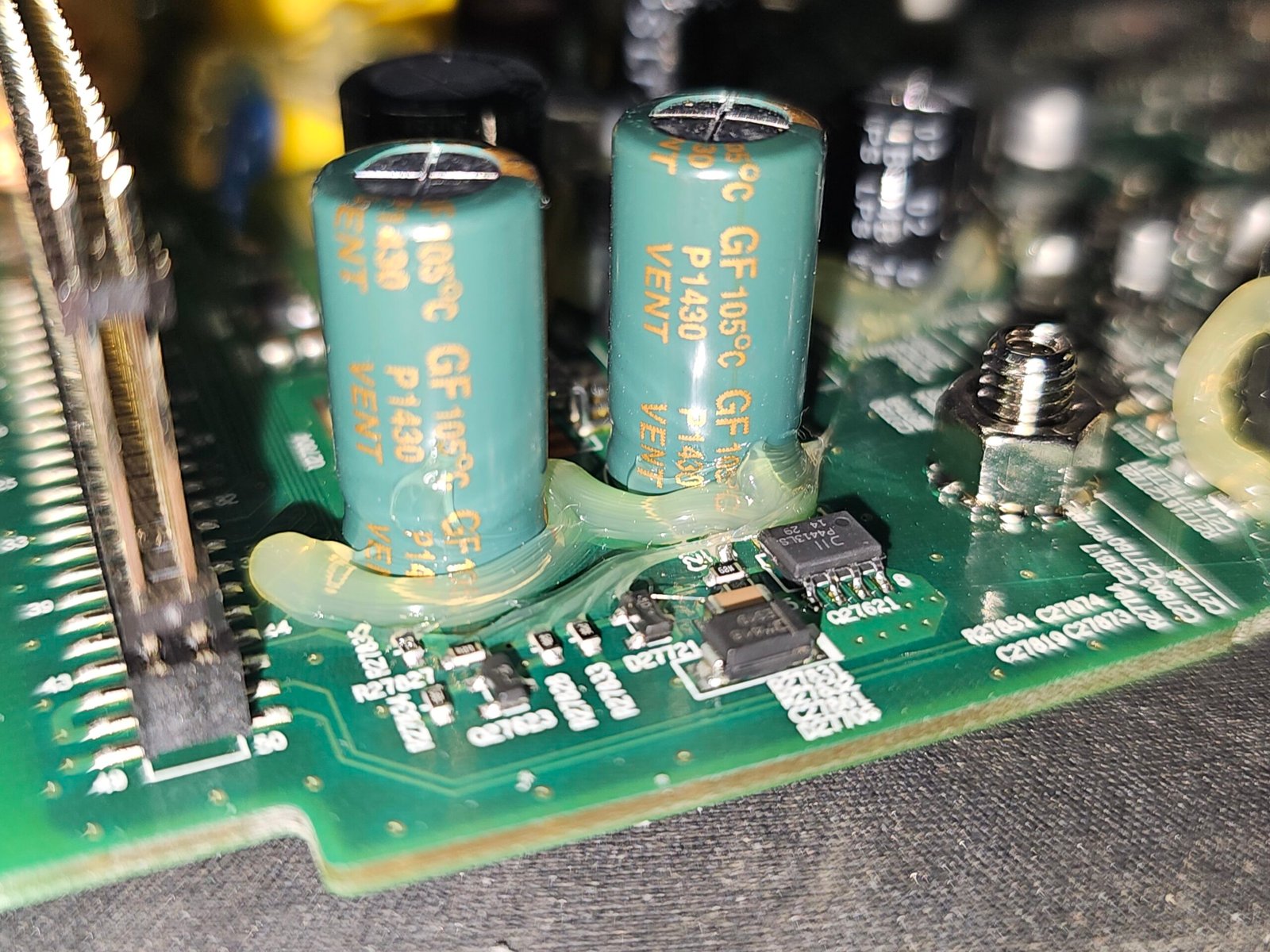
Take the two capacitors above, for example. They are both 470uF at 35v, and look good at first glance. They both tested extremely close (unfortunately, I didn’t take pics at that point); however, the readings seemed a little flakey as they would fluctuate, and were out of spec for ESR while in circuit, so I decided to remove them to test.
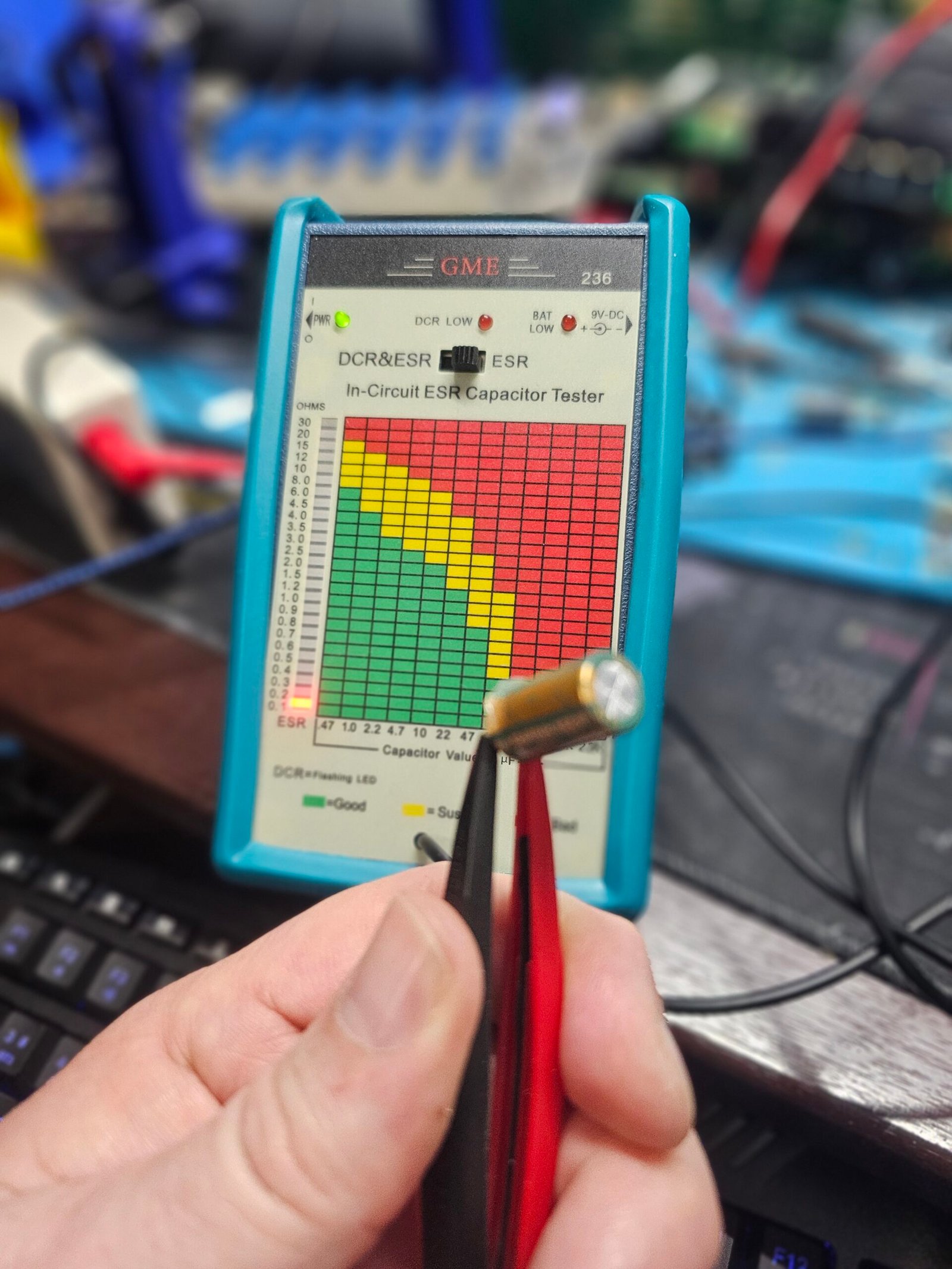
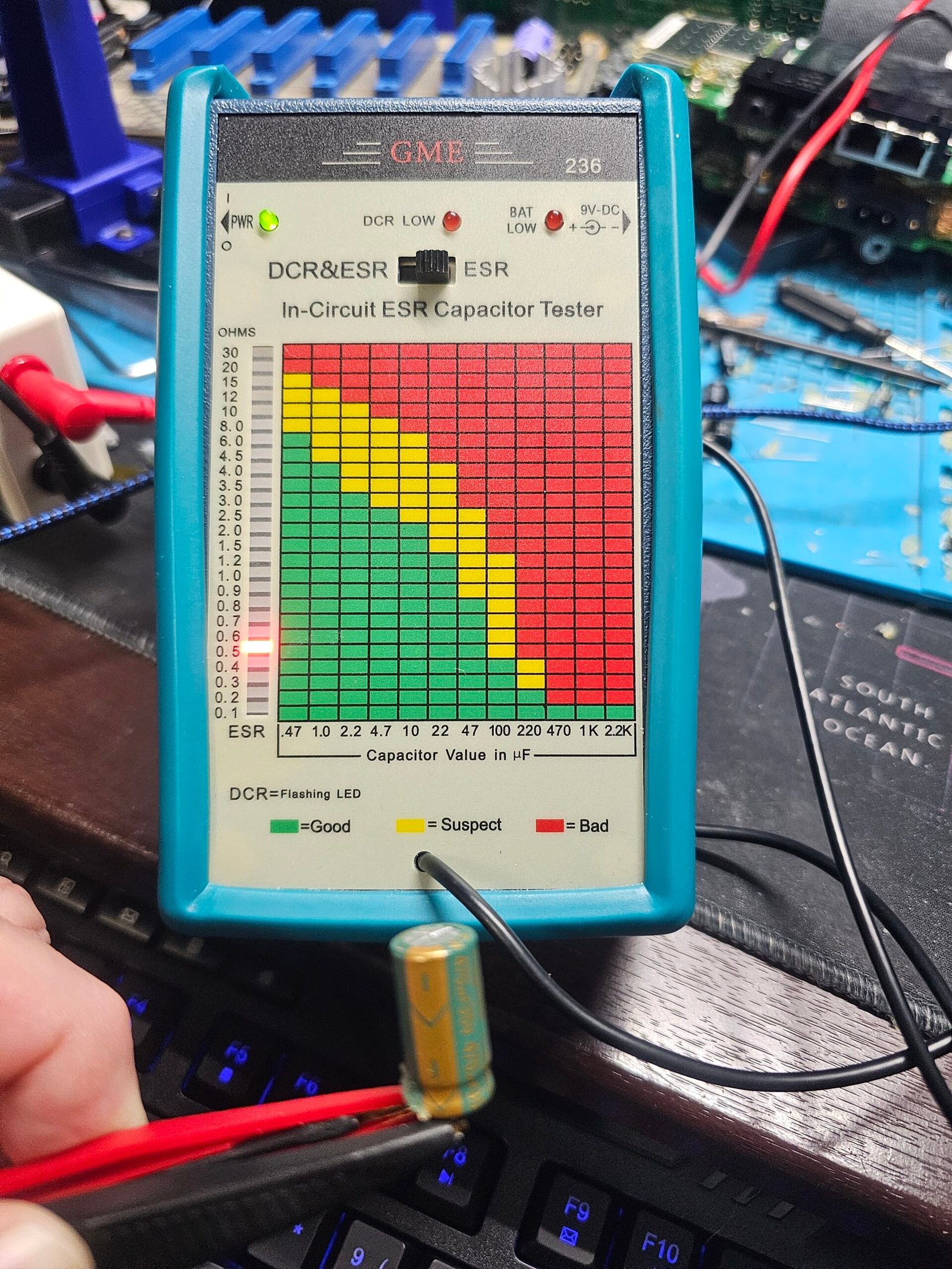
The ESR of the one on the left appears to be within a normal range. However, the one on the right is doomed.
This device uses a 100kHz sine wave to determine the ESR of the capacitor. The one on the left looks good, the one on the right, not so much. If you go back to the previous image above, with both caps still in circuit, you’ll see the one on the right is just beginning to pop it’s dome.
While the ESR of one is good, how about the capacitance rating? Is the either one still within spec, and still a 470uF capacitor? the GME doesn’t tell you that, it just gives you an idea of the ESR of that unit, based on a chart.
That’s where the Hantek 1833C comes in handy. With the Hantek (and other ESR meters) You can change between 300mv and 600mv, and you can also change the test frequency, ranging from 100Hz to 100kHz. When testing ESR in circuit, it’s usually done at 100kHz. When testing capacitance, especially on larger value caps, it’s generally more accurate at 100 or 120Hz. So you really need two tests to determine the condition of a capacitor.
Your ESR at the 100 or 120 Hz frequencies will not be accurate, but this frequency is meant only for testing the capacitance.
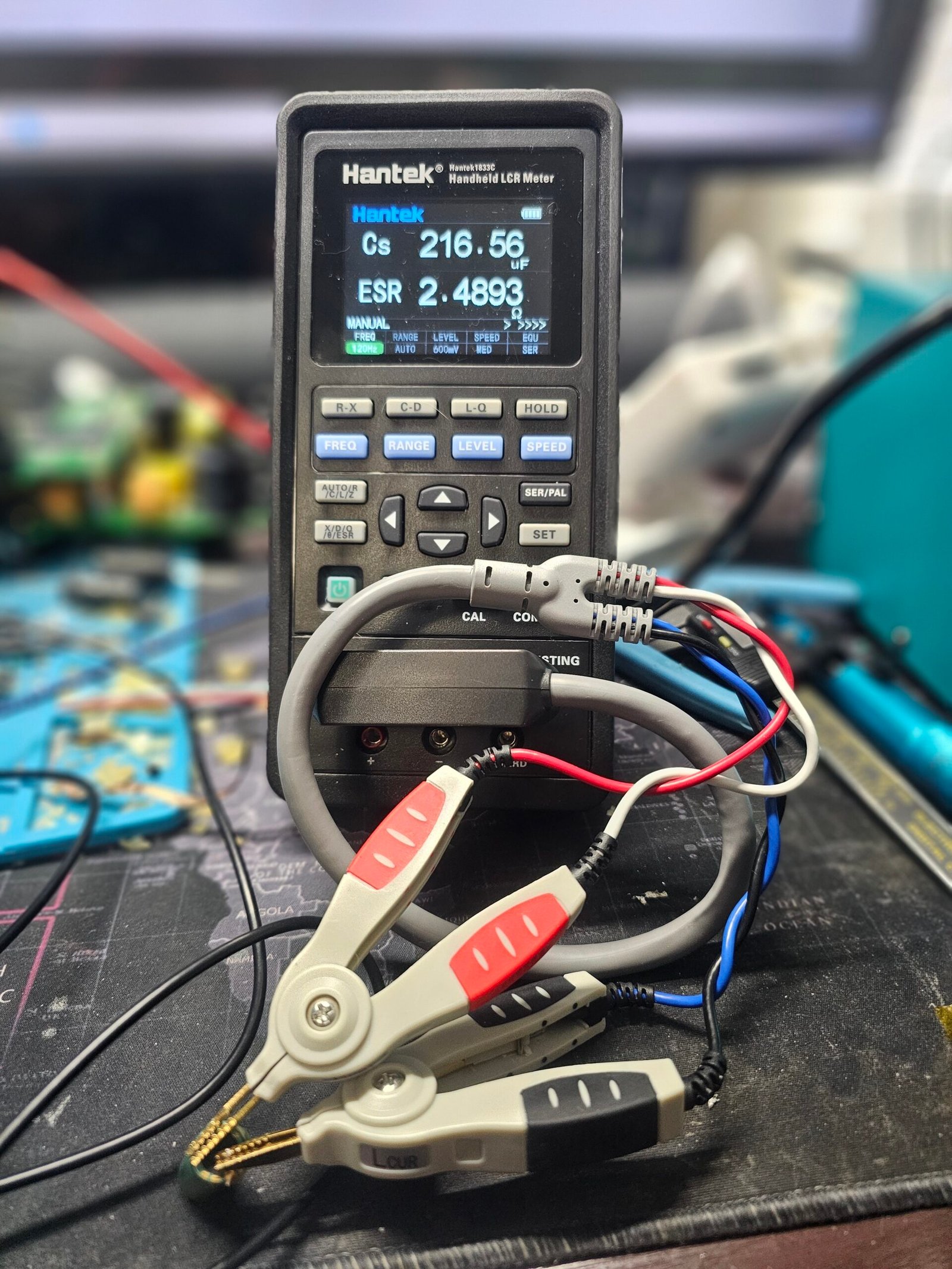
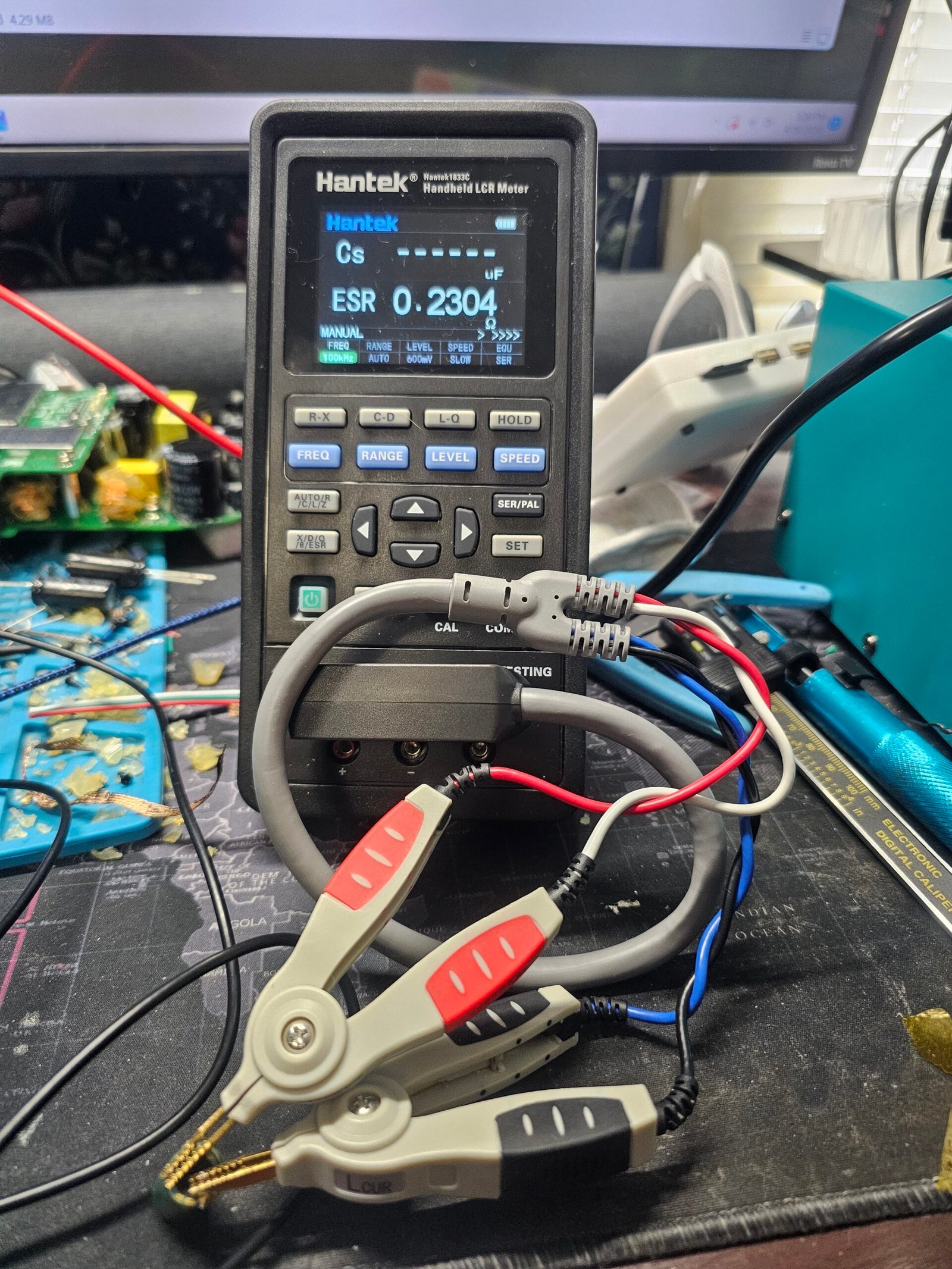
testing capacitance on the left, and ESR on the right. Again, this was the 470 uF 35v caps, the flat topped brother to the domed other. Rather, This was the one that had a slight bulging top, and no other obvious visual flaws. Also note that, at 100kHz, it was unable to determine a capacitance reading.
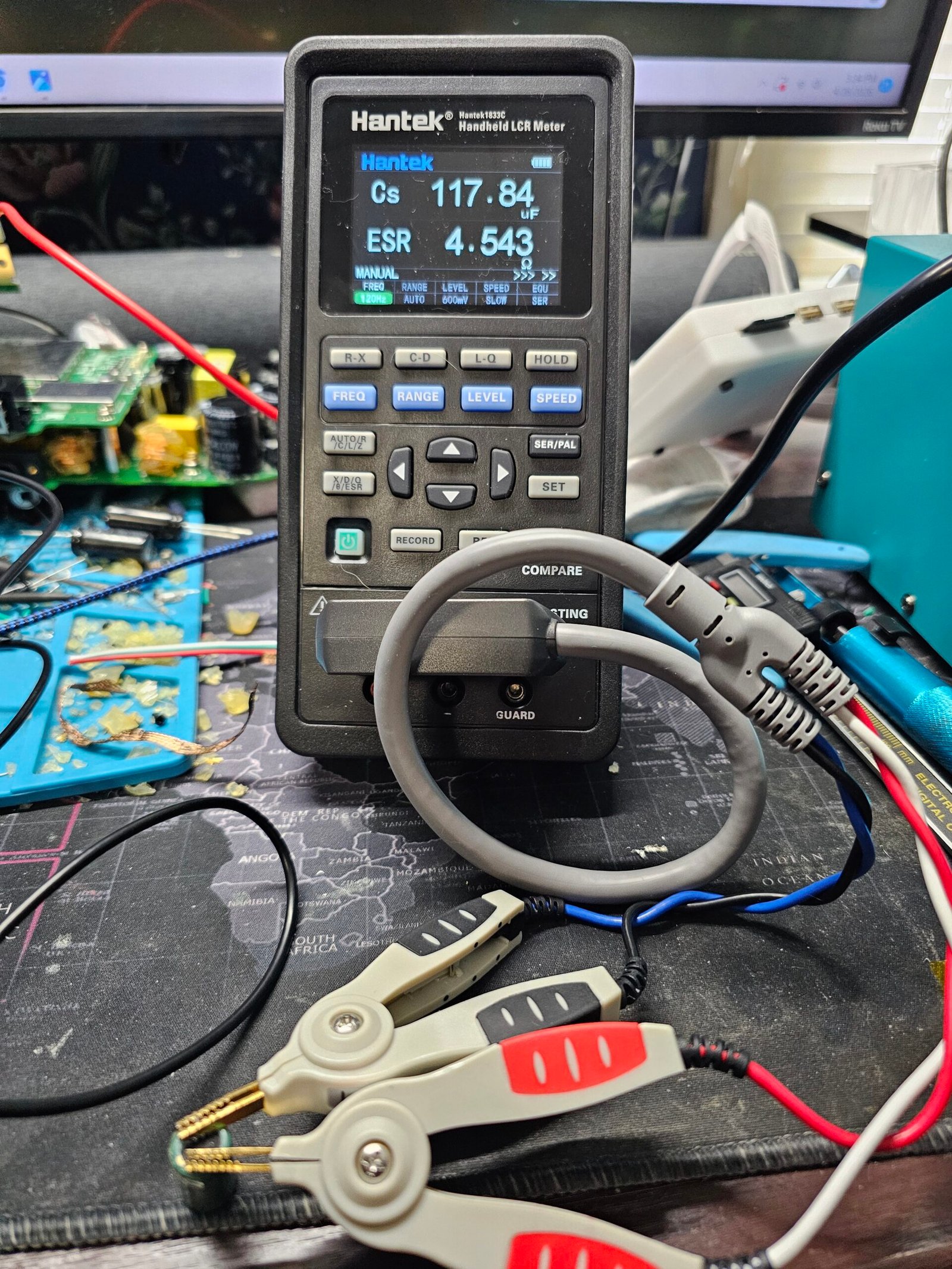
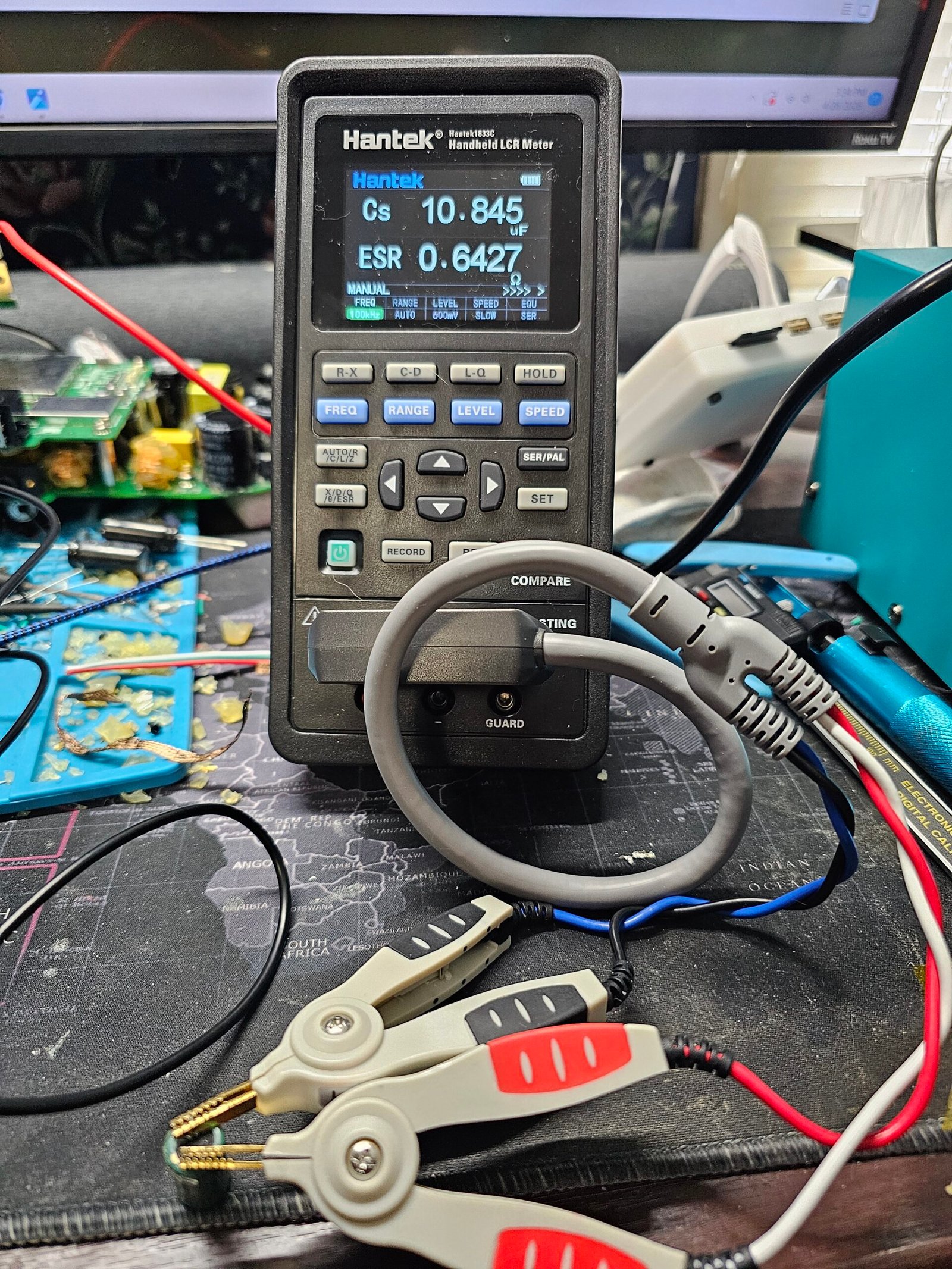
Testing capacitance on the left, and ESR on the right. Again, this was a 470 uF 35v cap. This was the slightly domed one, and no other obvious visual flaws. Also note that, at 100kHz (the right image), the domed cap, it DID try to get a capacitance reading. No matter how you cut it, though, BOTH caps are at least reading 50% less than their rated value, and their respective ESR readings are also out of spec – which is usually below .2 ohms..
Also of note, if you scroll back up to the images taken with the GME device, both ESR readings at 100kHz are very close to the Hantek readings.
Moral of the story:
I’m not going to tell you what to do or what not to do with items you’ve paid good money for. However, if you want to have that CoCo recapped, then make sure there’s a REASON to have it recapped. If you don’t have the tools to test it yourself, send it to someone, especially if you’re not handy with a soldering iron. While the Rocky Hill replacement boards are a fantastic resource, some of the parts to make a new coco are still tough to come by.
Furthermore, it doesn’t take much heat to damage these 40 – 50 year old retro PCBs. As I stated above, I’ve yet to see reason to do a blanket recap on anything made before 1998, really. Lots of people misinterpret the glue used at the factory as leaking electrolyte.
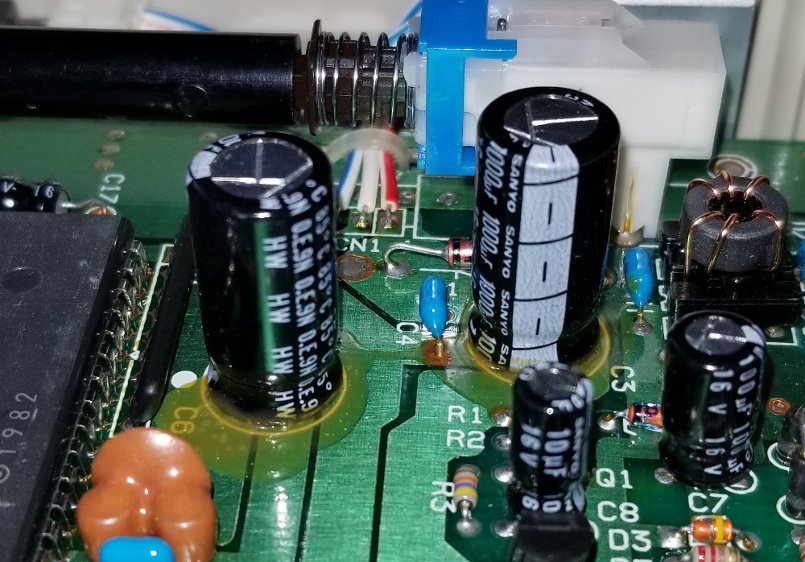
In the image above, that is manufacturer’s adhesive. Sometimes it’s a darker brown, which is what you’ll likely see on at least a CoCo 2 or 3.
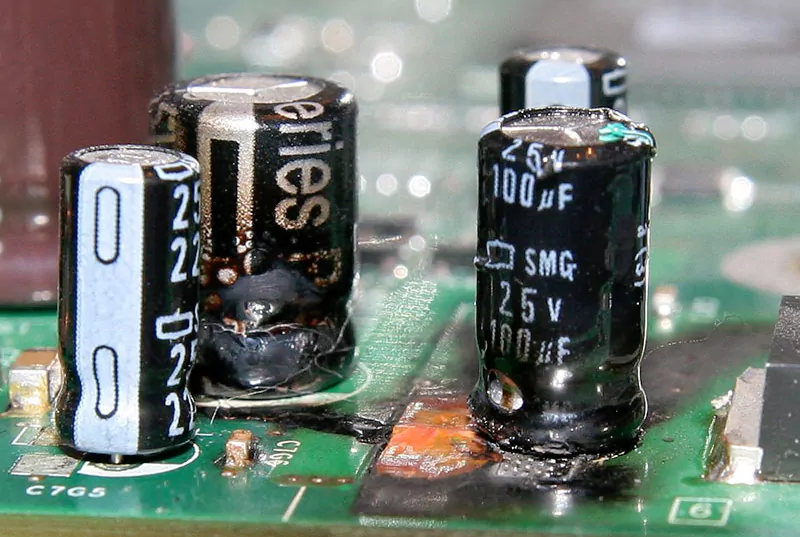
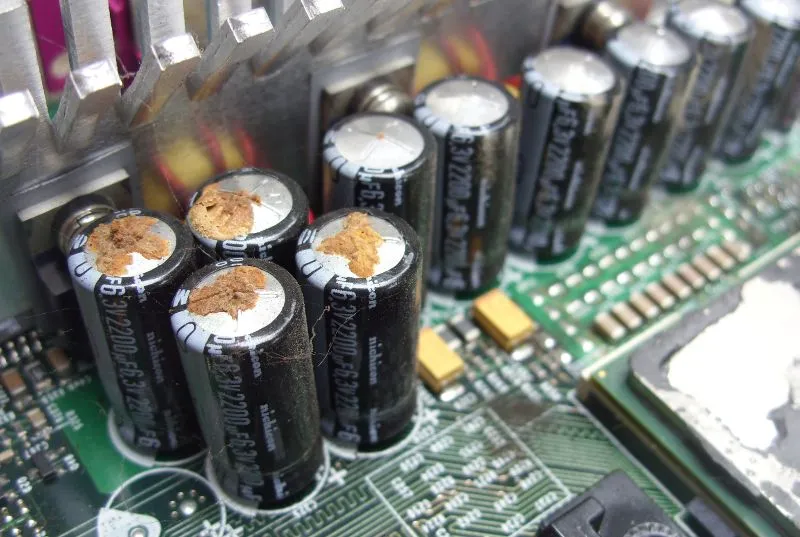
Above are two examples of leaking capacitors. Some blow out the top, if you’re licky; some blow out the bottom and physically damage your PCB. These are definiately examples of when a recap job is in order. So choose wisely on what you want done. Choose even more wisely WHO you want to do the work. If you’re not experienced with the staff of heat, find someone who is; and will be equally honest with you about whether it should be done in the first place. 